

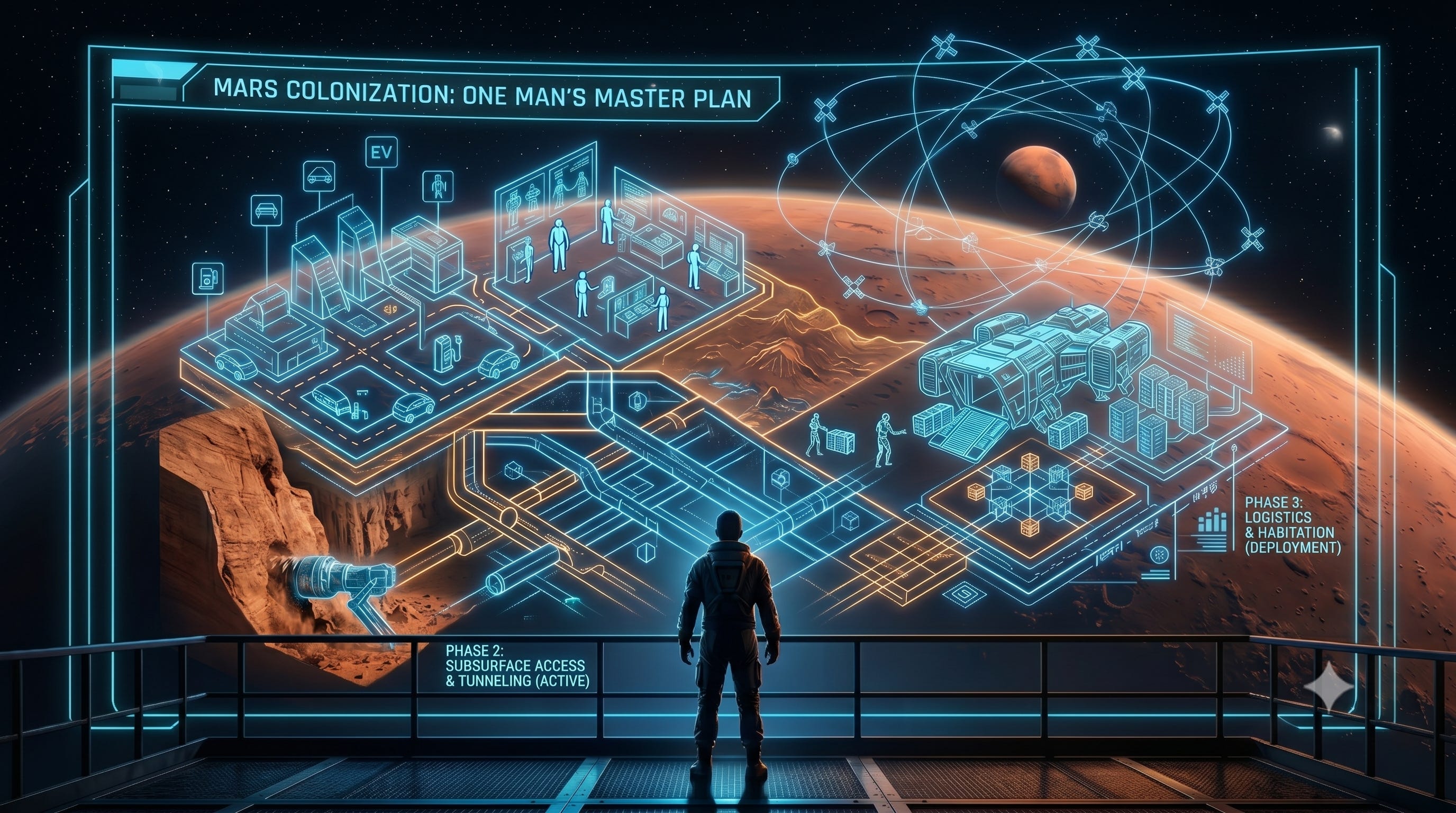
I spent this morning watching the SpaceX IPO. I had the Bloomberg open on one screen and the S-1 open on the other, and somewhere between the opening trade and the third panel debating the valuation, I stopped listening to the television and started really reading. The analysts were doing what analysts do: sum-of-the-parts math. Launch revenue here, Starlink subscribers there, an option value on Starship. Reasonable people doing reasonable work.
But the document in front of me wasn’t about parts. Buried in the language Wall Street had just priced at a trillion and a half dollars and bid up to $2T was a use of proceeds that included teh first city on Mars.
That was my jump-scare moment. The ambition is not news — but I realized I had done the same thing the analysts were doing. My mental model held each Musk company as its own story for two decades. A car company, a rocket company, a brain chip company, a tunnel company, whatever X was each year. Covered separately, valued separately, mocked or admired separately. This morning, with the whole thing wrapped in a single prospectus, I finally read it as one document. And once you read it that way, you can’t unsee it.
The thing that makes me feel dumb is that none of it was hidden. He published the architecture for a self-sustaining Mars city in a peer-reviewed journal in 2017. In 2021 he tweeted: “I am accumulating resources to help make life multiplanetary & extend the light of consciousness to the stars.” Accumulating resources. That is the entire org chart in two words. I read every piece as it was published and somehow never read the whole book…
The inventory
The story doesn’t start in 1999. It starts with a bullied kid in Pretoria who escaped into science fiction — specifically Asimov’s Foundation novels, whose entire premise is that civilizations fall and the wise build a backup. Musk has said it plainly: the Foundation series was “fundamental to creation of SpaceX”, teaching him to “prolong civilization” and “minimize the probability of a dark age.” When Falcon Heavy threw a Roadster past Mars orbit in 2018, the payload carried a copy of Foundation encoded on a crystal built to survive millions of years. He left South Africa at seventeen, made it to America, and as a Penn undergrad in the early ‘90s — two decades before any of this was investable — he was telling classmates which things would most affect the future of humanity: the internet, sustainable energy, and the extension of life to multiple planets.
The internet piece came first, in 1999, when Musk founded X.com with the goal of putting the entire global financial system at a single web address — money fully digitized, value moving peer to peer, no banks in the middle. The board pushed him out and narrowed the vision into PayPal, and people point to that ouster as proof there was never a plan. I read it the other way. He had learned what he needed to learn about moving money, banked $180 million, and refocused on space. Twenty-three years later he bought Twitter and told everyone exactly why: “an accelerant for X, the everything app.” Today X Money is live in early access, built with Visa and licensed in 41 states. The unfinished business of 1999 is getting finished, and along the way he also acquired the town square.
SolarCity was about capturing energy. Tesla is about storing it. The energy division deployed a record 46.7 GWh of storage in 2025 at roughly double automotive margins. The cars were the wedge that funded the real products: batteries, autonomy, and Optimus, the humanoid robot Musk now says will be 80% of Tesla’s value.
The Boring Company reads like a side project about urban congestion until you find the quote he gave in 2017: “You could build an entire city underground... getting good at digging tunnels could be really helpful for Mars.” Mars has no magnetosphere. Radiation shielding is available underground.
Starlink is the near term money printer, and he said so back in 2019: “We can use the revenue from Starlink to fund Starship... a key steppingstone towards establishing a self-sustaining city on Mars.” It worked exactly as described. Ten million subscribers, roughly $11 billion in revenue last year, and a proposal already sitting at NASA for MarsLink — the same constellation, around a different planet.
xAI’s founding mission statement isn’t about chatbots. It is, literally, “to understand the true nature of the universe” — the same sentence SpaceX has been saying with rockets. Neuralink, with 21 humans implanted and counting, is his stated bet on “symbiosis with artificial intelligence.”
Even DOGE fits. It lasted 130 days and ended in a public knife fight with the President. But look at what he walked away with: a ground-truth audit of how a government actually fails to serve its citizens at scale, the structural problems identified, the historical precedents catalogued. Then he was done. Extract the learning and move on.
The assembly, in public
In March 2025, xAI acquired X — the intelligence got the distribution and the data. In January, Tesla put $2 billion into xAI. In February, SpaceX acquired xAI outright, and Musk’s stated reasoning is very clear: terrestrial data centers are hitting power limits, so “the only logical solution” is to move compute to orbit. Days before the deal closed, SpaceX filed with the FCC for a constellation of one million solar-powered satellites. He promises data centers in space, within two or three years, at the lowest cost per unit of compute anywhere on or off Earth. The last domino is now openly handicapped on CNBC: a full Tesla–SpaceX merger, which Wedbush’s Dan Ives puts at 80–90% by 2027.
To the skeptics who say he can’t execute or it’s impossible, full self-driving has been “next year” since 2014. Mars cargo missions were promised for 2018, then 2022. Robotaxi today is about 20 unsupervised cars in Austin, not the ten cities he promised. But I the skeptics are probably grading the wrong measure of success because they misunderstand the mission. True, the dates slip constantly BUT the direction has not moved one degree in twenty-five years. When you’re working on a singular, life’s-work scale, the year-to-year timelines are noise. The vector is the signal to judge and Musk continues to be dead on his heading.
The sequence
Assembled from his own statements, in order, the plan is: Starship reaches Mars uncrewed — his stated target is the late-2026 window, at odds he puts at 50/50, with the gating technology of orbital refueling in testing now. The payload he’s announced is the Optimus robots. Tesla’s machines, riding SpaceX’s rocket, building before any human sows up on the red planet. The orbital compute and comms layer gets replicated around Mars, the robots and tunneling machines build the habitats underground, Starships bring it all up and Tesla solar and batteries power it all, and humans arrive years later to a colony that already works. Every watt of energy from his panels. Every payment digital. Every communication and vote on one network.
I include the votes because he has answered the governance question, in the strangest document in this whole story. Since 2020, the Starlink terms of service have stated that no Earth-based government has authority over Martian activities, and that Mars is “a free planet.” Lawyers say the clause is void under the Outer Space Treaty, and they’re probably right. But he’s got the only contract that contains a declaration of planetary independence. At SXSW he sketched the constitution — direct democracy, citizens voting on issues themselves. DOGE was the field study on how not to govern.
I learned a long time ago that the value in any industry eventually moves toward the people who know what should exist, who it’s for, and how to build it. If the thing that should exist is a civilization, you can spend twenty-five years quietly assembling every layer of its supply chain in public, and the world will keep grading each piece separately.
I don’t know who gets to go. He’s said the trip should be affordable to almost anyone. He’s also building a world where the labor is robotic, the intelligence is artificial, and the infrastructure belongs to one man before the first settler lands. Whether that’s the ark or the Hotel California is a question left open.
What I know is that as of this morning, you can buy a share of it.
Very fun write up, appreciate you laying it out