

May 04, 2026
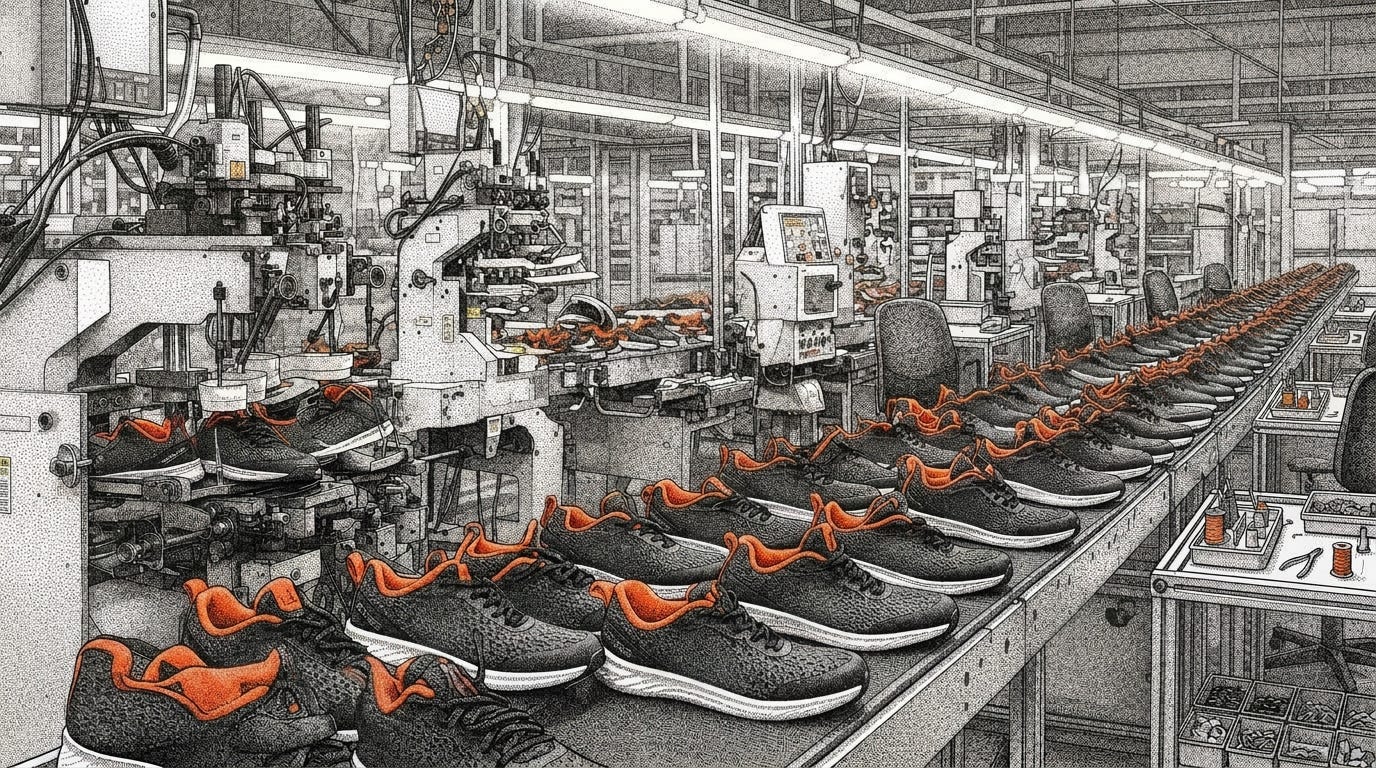
My first day in Taiwan working for AND 1 taught me a ton. It was 1998, and I flew from Philadelphia to Taipei, and then drove to Taichung. I met my boss for the first time and handed over a tube of blueprints I’d carried from the U.S. as if they were the Dead Sea Scrolls. He spread them out on the table, made a few edits and rolled them back into the tube. He handed it to me along with an address. With a member of our local development team, we drove to the address, which dropped us in front of a metal roll up door in an alley in the middle of the city. Inside, there was an older man dressed in coveralls and a white undershirt, cigarette dangling from his fingers, a Dremel tool on the bench next to him.
At the instruction of my colleague, I handed him the tube of blueprints. He pinned them to the wall above the bench, put the cigarette to his lips, grabbed a balsa wood blank of a midsole and fired up the Dremel. In a few minutes, a scale 3D model of the midsole/outsole design was complete. He repeated this process three times. Each time, pausing just long enough to light a new cigarette.
My mind was blown at the accuracy of his hand. He also understood the engineering of a shoe and would make adjustments to the two dimensional design that accounted for construction methods, manufacturing process at scale and durability of the overall end product. He would note these modifications after the 3D model was carved.
We took digital pictures, emailed them back to our designers in the U.S. and iterated on the design over a week or two. Once the design was finalized, our factory partners created sample molds and FedExed midsole/outsole combinations back to the product team in the U.S. for review. The design edits were done with masking tape and pencils on the 3D samples, shipped back to Asia for mold modifications and the process repeated until the sample was approved. From there, production molds were carved in aluminum and production samples were built in China. I would travel there, via Hong Kong, and review the production version before final costing and duty engineering were complete.
About two years after I started making these trips, I was between Guangzhou and Dongguan at a factory, speaking with a production manager when the CNC machine behind me sprang to life, carving metal. After I recovered from the jump scare, I asked what happened. They told me that NIKE’s design team back in Oregon had pressed “print.”
The evolution from craft to automation immediately hit home for me. And with that, I felt the fear of being on the wrong side. NIKE had compressed its design timelines by using CAD software, building deeper factory partnerships and investing in the ability to carve production-grade aluminum molds earlier in the iteration process. Technology allowed them to define a spec, deliver it to the factory and have a production ready product back in a matter of days.
As production became faster, more precise, and more abstracted, the value in sneakers moved away from the hands that made the product and toward the people who knew what should exist, who it was for, and how to sell it. The best sneaker brands did not ultimately win because they owned every step of production. They won because they understood the customer, defined the product, shaped the taste, and then built demand. The factories became more capable and more specialized, while the brands moved closer to the market.
Historically, when a craft evolves into mass production, sources of value creation shift.
For decades, code was treated as the core asset in technology. Companies that wrote the software also owned the production process, the customer relationship, and the product vision inside one organization. AI is beginning to pull those pieces apart. Code is easier to generate, cheaper to modify, and less defensible as a standalone advantage. The scarce work is shifting upstream and downstream. Knowing what to build, specifying it clearly, evaluating whether it works, and getting it into customers’ hands is becoming the new core asset class.
In sneakers, production became commodity. It moved to third-party factories overseas, and the brands that won poured their energy into product vision, taste, and distribution. I ultimately think software will be built just like this. The best brands will deeply understand exactly what to build (define the product) and how to get it into people’s hands (own the customer), and then outsource to “factories” to to run and maintain the software.
The sneaker playbook has three parts
The sneaker industry eventually settled into a clear division of labor.
The customer buys the shoes.
The brand — Nike, Adidas, New Balance — designs the product, invests in R&D, owns the customer relationship, and defines what gets built.
The factory — Pou Chen, Feng Tay, Chang Shin — prototypes, produces, and ships to meet the spec delivered by the brand and the SLA contracted for delivery dates and quality.
The role of the brand shifted from the craft of building a product to evaluating the output of a factory. AI will drive the software industry toward the same three-player structure.
Most people imagine an AI future where every end user talks directly to an AI and gets custom software. That’s the Nike By You version — it’ll exist but i don’t think it’s the majority of software. Most people don’t want to create software. They want to use it.
Software vendors realize their value was never in the code and become brands. They understand the user’s needs, curate the experience, make opinionated design choices, and own the customer relationship. The code is just the fulfillment mechanism — and it is the most expensive, slowest, most error-prone part of the entire operation. It should be outsourced.
In this new model, software vendors stop employing large engineering orgs and start pointing factories at customer problems. Their competitive advantage shifts from engineering capacity to customer insight, domain expertise, and product taste. They become like Nike — they design, they do R&D, they own the customer. The factory builds, tests, ships, monitors, maintains, and is accountable to the brand’s requirements, continuously.
The factory owns production end to end. Build cost and timeline. Scalability, reliability, maintenance. Performance spec and infrastructure efficiency. Security. The expertise required to run a high-functioning software factory — the harnesses, the testing frameworks, the deployment pipelines, the production monitoring — becomes its own deep specialization. Just as a handful of contract manufacturers produce most of the world’s sneakers, a small number of software factories will serve the vast majority of demand.
The customer just uses the product. But the product is better now, because the brand isn’t constrained by engineering capacity anymore. When building is cheap and fast, the brand can customize deeply instead of building for the average. It can ship more frequently and consistently. The customer doesn’t know or care that a factory built it. They just know the product works.
Why now
Three engineers at OpenAI just built a million-line production system in five months. Zero hand-written code. Cloudflare rewrote Next.js in a week for $1,100 in tokens. Coinbase found that engineers using agents heavily are 16x more productive than light users. StrongDM built digital twins of Okta, Slack, and Jira so agents could test at scale without touching production, operating under two rules: code must not be written by humans, and code must not be reviewed by humans.
These are the beginnings of software factories. They just don’t call themselves that yet. The emerging behavior from teams actually running these systems: if your codebase doesn’t work with agents, don’t make agents work with your codebase. Reduce it to specifications and let agents rebuild it from scratch. When a full rewrite costs $1,100 and produces a codebase purpose-built for agent maintenance, the calculus changes for everyone.
The entire installed base of software in the world was written by humans, for humans to maintain. That assumption has been invalidated. A new company architecture is needed.
The brands that move first — that swap their engineering orgs for factory relationships — will be able to build faster, customize more efficiently, and iterate continuously while their competitors are still managing sprint planning and customer tickets.
Who builds the factory? Who builds the brand?
The natural assumption is that OpenAI, Anthropic, or Google will be the factory. They have the models. They have the agents. They have the money.
But go back to the sneaker analogy. The model companies are the material suppliers — the companies that make the yarns and polymers. Essential inputs, but not the factory and definitely not the brand. The winning software factory will be model-agnostic, sourcing the best intelligence at the best price from whoever makes it, swapping models in and out as capabilities shift without customers ever knowing.
The factory of the future isn’t a coding agent, an IDE plugin, or a model API. It’s a full-stack service that accepts a spec from a brand and delivers running software continuously. That means model orchestration, code creation, hosting, implementation, testing, deployment, monitoring, maintenance, evolution. End to end.
Nobody has built this yet. But the pieces are falling into place fast. A factory isn’t a demo you vibe code in a weekend. It’s harnesses and production ownership — deep, compounding infrastructure that becomes exponentially harder to compete with once it’s running.
Nike started as Blue Ribbon Sports — a distributor of Tiger running shoes from Japan. Phil Knight’s advantage was understanding the American runner better than a Japanese factory could. Over time, the relationship evolved: from distributing product designed and built by a third party, to influencing design based on customer knowledge, to a full brand-factory relationship where Nike’s customer and market insight defined the product and the spec was delivered to the factory to build to order.
Software brands will follow the same arc and soon a founder with deep domain expertise and customer insight will be able to point a factory at a problem and ship product. If the factory builds the code and hosts it and maintains it, the brand just needs taste and the customer relationship.
The factory opportunity is equally large but fundamentally different. Factory founders are experts in every aspect of scaling software from code to physical infrastructure, cloud deployment, and optimization. They serve both existing brands making the transition and new brands emerging native to this model. Their competitive advantage compounds: every spec they fulfill, every system they maintain, every deployment they optimize makes the next one better and cheaper.
The sneaker industry proved that brands and factories are both massive, generational businesses, but they are fundamentally different companies. Nike owns demand. Pou Chen owns production at scale. Both won.
The same split is about to happen in software. Both sides of the value chain are up for grabs.
The founders who see this — who understand that the opportunity isn’t building better coding tools but building either the first true software factory or the brand layer that specs, sells, and owns the customer — are going to build some of the most important companies of the next decade.
what a piece. we track vc newsletters at byblos and this code idea reframe is showing up across so many theses right now
Incredible! I aspire to write as well as you do!